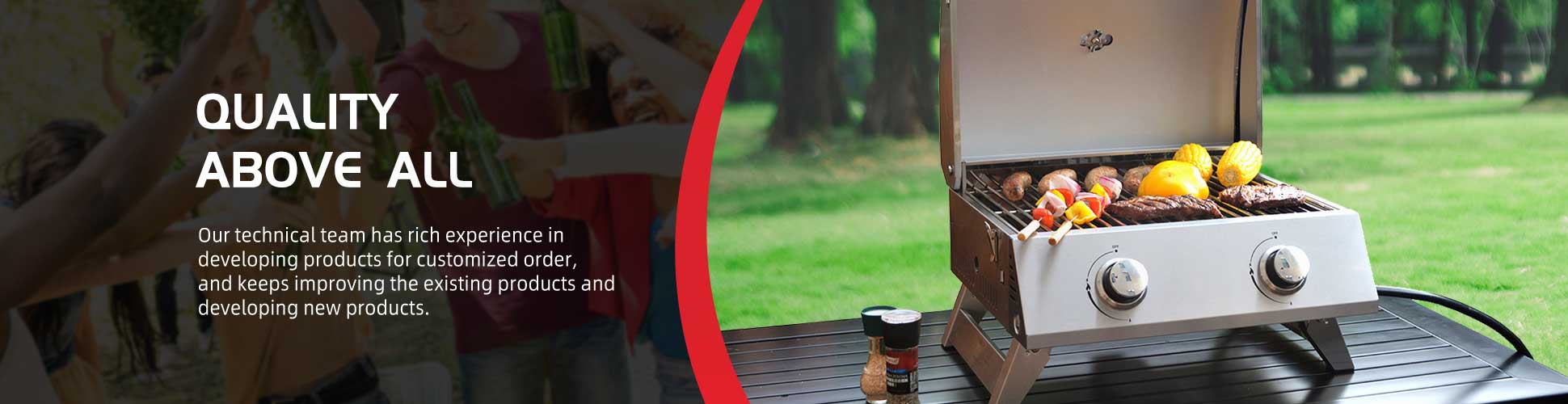
A portable Gas grill is best for camping, picnics, tailgating, and limited outdoor spaces, while a full-size Gas Grill is generally better for frequent backyard cooking, larger groups, and more cooking flexibility. The right choice depends on cooking area, portability, fuel supply, storage space, and how often the grill will be used.
The main difference is the balance between mobility and cooking capacity. Portable grills prioritize easier transport and compact storage, while full-size grills typically provide more cooking space, additional burners, and room for accessories.
However, grill size alone does not determine performance. A well-designed portable grill can be suitable for regular outdoor meals, while an oversized grill may be inconvenient for someone who cooks for only one or two people.
| Comparison factor | Portable gas grill | Full-size gas grill |
|---|---|---|
| Main purpose | Camping, picnics, tailgating, small patios | Backyard cooking, family meals, entertaining |
| Cooking area | Usually smaller, although some folding models offer substantial space | Generally larger, with more room for multiple foods |
| Portability | Designed for easier transport or storage | Usually heavier and intended to stay in one location |
| Setup | Often simpler, depending on the design | May require more space and setup |
| Cooking capacity | Best suited to smaller batches or moderate quantities | Better for preparing several dishes or larger quantities together |
| Temperature management | Depends on burner design and cooking surface | Multiple burners may allow more flexible heat zones |
| Storage | Compact models can fit in smaller storage areas | Requires more floor space |
| Fuel arrangement | May use small gas cartridges or compatible cylinders | Often uses a larger compatible cylinder or an approved fixed gas connection |
| Cleaning | Smaller surfaces can be easier to clean, but components still need regular maintenance | Larger cooking and grease-management areas may require more cleaning |
| Best buying priority | Weight, packed dimensions, setup, and fuel compatibility | Cooking area, burner configuration, durability, and convenience |
These are general category differences rather than guarantees for every model. A large foldable grill may offer more cooking space than a compact stationary grill, so specifications should be compared before making a purchase.
A portable gas grill is better when mobility, storage, and occasional outdoor cooking are the main priorities. A full-size gas grill is usually better when cooking for several people regularly and keeping the grill in a dedicated outdoor area.
The best option depends on the intended use rather than the assumption that a larger grill is automatically more powerful or versatile.
Choose a portable gas grill if the grill needs to move between locations or fit into a limited storage area.
Portable models are particularly useful for:
Camping trips and outdoor excursions where gas grilling is permitted.
Tailgating and picnics.
Small patios, balconies where permitted, and compact outdoor areas.
Couples, small households, or occasional outdoor meals.
Buyers who need a grill that can be stored after use.
Before buying, check the actual weight, folded dimensions, carrying method, and fuel requirements. A grill described as portable may still be too large or heavy for backpacking, and a wheeled folding model may be more suitable for car travel than for carrying long distances.
A full-size gas grill is generally the better choice when outdoor cooking is a frequent activity and several dishes need to be prepared at the same time.
Consider a full-size model if:
Outdoor meals regularly involve larger families or groups.
Different foods need separate cooking zones.
The grill will remain in a backyard, patio, or dedicated outdoor cooking area.
Extra working space, warming racks, side shelves, or multiple burners are important.
The grill needs to handle longer cooking sessions or a wider range of meal preparation tasks.
A larger grill also requires more room for safe operation, cleaning, and storage. Measure the available space and check the manufacturer's required clearances before choosing a model.
Cooking area is one of the most useful specifications when comparing portable and full-size gas grills. It indicates how much food can fit on the cooking surface, but it does not directly measure cooking speed or heat distribution.
A practical way to estimate the required area is to consider the number of people, the type of food, and whether different foods must be cooked simultaneously.
| Typical use | What to prioritize |
|---|---|
| One or two people | Compact cooking surface and easy storage |
| Small family meals | Enough room for the main dish and side ingredients |
| Family gatherings | Larger cooking surface and adequate heat control |
| Parties or frequent entertaining | Multiple cooking zones and sufficient capacity for cooking in batches |
| Camping or travel | A manageable balance between cooking area and transport dimensions |
These are planning guidelines, not fixed capacity limits. Burgers, vegetables, skewers, steaks, and larger cuts of meat occupy different amounts of space and require different cooking arrangements.
The external dimensions include the lid, body, legs, handles, and other structural components. These dimensions do not show how much space is available for food.
When comparing specifications, look for:
Primary cooking area, excluding warming racks where possible.
Number of burners and whether they can be controlled independently.
Shape and arrangement of the cooking grate.
Space needed to turn food without overcrowding.
Whether the grill can maintain appropriate heat across the cooking surface.
A larger cooking surface is useful only when it supports the intended cooking style. For a small household, a compact grill may be more practical than a large model that takes longer to clean and requires more storage space.
Yes. A portable gas grill can provide sufficient heat for many everyday grilling tasks, but the result depends on its burner output, cooking surface, heat retention, and temperature control.
BTU, or British Thermal Unit, is a measure of heat output. It should not be used alone to judge whether a grill cooks well.
A useful comparison includes:
Total burner output: Check whether the published BTU figure refers to the main cooking burners or includes additional burners.
Cooking area: Compare heat output with the primary cooking surface rather than relying on the total BTU number.
Heat distribution: Consider burner placement and whether the design supports even cooking.
Temperature control: Check whether the grill can support both high-heat searing and lower-temperature cooking when required.
Heat retention: The lid, body construction, and cooking grate can influence how the grill responds to changes in temperature.
A full-size grill with several independently controlled burners may make it easier to create separate heat zones. However, a smaller grill with a suitable burner design can still perform well for its intended cooking tasks.
For buyers comparing products, cooking area and burner layout should be assessed together. A high BTU rating does not automatically mean faster cooking, more even heat, or better food quality.
Fuel compatibility is a practical buying consideration because portable and full-size grills may use different gas supply arrangements.
Portable models may use compatible butane cartridges or propane cylinders, while larger grills may use propane cylinders or approved natural-gas connections, depending on the design.
| Fuel consideration | What buyers should check |
|---|---|
| Butane | Confirm the specified cartridge type, operating conditions, and compatible connection |
| Propane | Check the approved cylinder, regulator, hose, and operating pressure |
| Natural gas | Confirm that the grill is specifically designed or approved for the intended natural-gas supply |
| Fuel availability | Check whether replacement fuel is readily available at the intended destination |
| Cooking duration | Estimate how long the grill will operate under the expected cooking conditions |
| Transport and storage | Follow the fuel supplier's and grill manufacturer's requirements for handling and storage |
Never assume that butane and propane are interchangeable in a particular grill. Do not modify gas fittings or use a fuel type that is not specified by the manufacturer.
For portable cooking, the availability of compatible replacement fuel may be just as important as the grill's weight. For a stationary outdoor cooking area, a larger approved fuel supply may be more convenient.
Always operate gas grills outdoors in a well-ventilated area, away from enclosed spaces and in accordance with the manufacturer's safety instructions.
Neither type is best for every buyer. The decision depends on which limitations are easiest to accommodate.
Advantages
Easier to transport than most full-size grills.
Suitable for small outdoor spaces and occasional trips.
Often simpler to store when not in use.
Can reduce the amount of space required for outdoor cooking.
Folding designs can combine a larger cooking surface with easier storage.
Disadvantages
Some models have limited cooking space.
Small fuel containers may require more frequent replacement.
Compact designs may provide fewer independent heat zones.
The actual weight and folded size may limit transport options.
Some models offer fewer shelves or preparation areas.
Advantages
Usually offers more cooking area.
Better suited to preparing several dishes simultaneously.
Multiple burners can support different cooking temperatures.
May include additional shelves, warming racks, and storage.
Suitable for frequent cooking in a dedicated outdoor space.
Disadvantages
Requires more storage and operating space.
Can be harder to transport.
Cleaning a larger cooking surface may take longer.
May require a larger compatible fuel supply.
Can be excessive for buyers who cook small quantities infrequently.
A useful purchasing principle is to prioritize the limitation that would cause the greatest inconvenience. If insufficient cooking space would repeatedly delay meals, a larger grill may be worthwhile. If storage and transportation are the main obstacles, a compact or foldable design may deliver more practical value.
MINSHENG offers different gas grill configurations for different outdoor cooking requirements. The following examples illustrate how to compare actual specifications rather than relying on product labels alone.
The MINSHENG Portable Butane Grill is a compact option for buyers who prioritize a smaller footprint and portability.
Published specifications include:
Model: MK-1B02-Black lid.
Heat output: 7,000 BTU.
Cooking area: 290 mm diameter.
Product dimensions: 410 × 410 × 605 mm.
Cooking grid: Enamel-coated cast iron.
Flame tamer: SS430 stainless steel.
This configuration is suited to buyers who value compact dimensions and a relatively small cooking surface. The circular grate is an important specification to consider when estimating how much food can be prepared at one time.
Before selecting this model for a particular market, buyers should confirm the compatible butane cartridge, local fuel requirements, and intended operating conditions.
The MINSHENG Portable Foldable Gas Grill with Black Lid offers a larger cooking surface while retaining a foldable design.
Published specifications include:
Model: MK-1B01-Black lid.
Heat output: 15,000 BTU.
Cooking area: 348 square inches.
Product dimensions: 1,040 × 530 × 900 mm, as listed on the product page.
Cooking grate: Cast iron.
Burner: Stainless steel.
Body material and finish: SPCC with powder-coated or enamel finish.
Its 348-square-inch cooking area provides substantially more cooking space than the compact butane model described above. The folding legs and wheels are relevant to buyers who need to move or store the grill between uses.
However, folding construction does not automatically make a grill suitable for every travel situation. Buyers should confirm the folded dimensions, total weight, transport method, and storage requirements before ordering.
This product is also a useful reminder that portable and full-size grills are not always sharply separated categories. A foldable grill can provide a comparatively generous cooking area without being a traditional fixed backyard unit.
The MINSHENG Tabletop Grill is another configuration worth considering when a buyer wants a compact grill that sits on a suitable support surface.
The published specifications include:
Model: TGO01.
Heat output: 10,236 BTU.
Primary cooking area: 445 × 315 mm.
Warming area: 385 × 167 mm.
Cooking grid and warming rack: SS304 stainless steel.
Lid and firebox: Porcelain-enamel steel.
Its rectangular primary cooking surface may suit buyers who want to arrange several types of food on the grate. The separate warming area is another feature to consider when comparing cooking arrangements.
A tabletop design still requires a stable, heat-resistant support surface and adequate clearance. It should be used only in locations and under conditions approved by the manufacturer.
| Specification | Portable Butane Grill | Foldable Gas Grill | Tabletop Grill |
|---|---|---|---|
| Published heat output | 7,000 BTU | 15,000 BTU | 10,236 BTU |
| Primary cooking area | 290 mm diameter | 348 sq in | 445 × 315 mm |
| Cooking grate | Enamel-coated cast iron | Cast iron | SS304 stainless steel |
| Main design priority | Compact portability | Larger cooking surface with folding construction | Tabletop cooking with a separate warming area |
| Key buying consideration | Fuel cartridge compatibility and compact capacity | Folded dimensions and transport requirements | Stable support surface and available tabletop space |
The figures above are published product specifications, not the results of comparative laboratory testing. The models use different cooking surface shapes and construction designs, so heat output alone should not be treated as a direct measure of cooking performance.
For a buyer choosing between these configurations, the most useful question is not simply which grill is larger. It is which combination of cooking area, fuel arrangement, storage, and maintenance best matches the intended use.
The required space includes more than the grill's footprint. It must also accommodate safe clearance, access to controls, ventilation, and room for the person cooking.
Before purchasing a grill, measure:
The available floor or tabletop area.
The clearance required from buildings, railings, overhead structures, and combustible materials.
The space needed to open the lid fully.
Room for the gas cylinder or approved fuel connection.
Storage space when the grill is not being used.
Access needed for cleaning and maintenance.
A portable grill may be easier to store, but it must still be placed on a stable surface and operated according to its safety instructions.
Do not use a gas grill in an enclosed garage, tent, vehicle, or other unventilated area. For apartments, balconies, campsites, and public parks, confirm the relevant property rules and local restrictions before use.
A portable grill often has less surface area to clean, while a full-size grill may require more time to maintain because it has a larger cooking surface and additional components.
However, the ease of cleaning depends heavily on the design.
When comparing models, check whether:
The cooking grates can be removed easily.
The grease tray or collection cup is accessible.
The interior can be cleaned without dismantling complex components.
The materials have clear care instructions.
Burner ports and ignition components can be inspected safely.
Replacement parts and maintenance guidance are available.
Regardless of size, turn off the gas and allow the grill to cool completely before deep cleaning or removing components. Clean grease collection areas regularly and inspect burners for blockages or damage.
A grill that is easy to maintain may be more convenient over its service life than one selected only for its appearance or advertised heat output.
Yes, some portable gas grills can support family meals, depending on the cooking area, burner output, and the quantity of food being prepared. Models with larger grates may be suitable for small family gatherings, while compact tabletop units may require cooking in batches.
A full-size grill can consume more gas when it operates at a higher total heat output or uses more burners. Actual consumption depends on burner settings, cooking duration, fuel type, and grill design. Compare the manufacturer's fuel-consumption specifications where available rather than relying on grill size alone.
It may be suitable for regular backyard use if the manufacturer permits it and the grill meets the cooking requirements. However, a fixed outdoor grill may be more convenient for buyers who need a large cooking surface, additional preparation space, or multiple heat zones.
No. A foldable grill describes a design feature, not a standardized size category. Some folding models have relatively large cooking areas, but their portability, stability, and storage requirements still need to be evaluated separately.
A compact portable grill is generally more convenient for camping because it is easier to transport and store. Before choosing one, check its fuel compatibility, packed dimensions, weight, and whether gas grilling is permitted at the destination.
No. BTU indicates heat output, but cooking performance also depends on cooking area, burner placement, heat distribution, temperature control, and heat retention. A grill should be evaluated as a complete system rather than by a single specification.
Choose a portable gas grill when easy transportation, compact storage, and flexible outdoor use matter most. Choose a full-size gas grill when larger cooking capacity, multiple heat zones, and frequent backyard entertaining are the priorities.
For buyers comparing MINSHENG products, the compact butane grill, foldable gas grill, and tabletop grill demonstrate that different configurations can serve different needs. Comparing actual cooking area, heat output, fuel compatibility, materials, and storage dimensions is more reliable than making a decision based on the product category alone.
For manufacturers, importers, and distributors, the same principle applies to product selection: the most suitable grill is the one that matches the target customer's cooking habits, available space, fuel infrastructure, and maintenance expectations.
Explore the MINSHENG Gas Grill Product Range to compare available configurations and identify a model suited to the intended application.